Flapless Implant Treatment
A surgical approach that may allow implant placement without a wide gum incision or sutures in suitable cases, supported by 3D imaging and digital planning.
Book via WhatsAppWhat is flapless implant treatment?
Flapless implant treatment describes placing an implant through a small access point without lifting a broad section of gum tissue in a suitable case. Because a flap is not raised, sutures are often unnecessary.
This is not a different type of implant. It is a placement approach; the implant, restoration and healing phase still follow the principles of conventional implant care.
Who may be suitable?
The flapless approach is not suitable for every person or every implant site. Adequate bone and healthy gum tissue, a predictable implant position and the ability to work safely without direct visual access are important. A panoramic image alone is not enough to make this decision.
- Clinical examination of the mouth and gums
- Assessment of bone and nearby anatomy with 3D dental imaging
- Intraoral scan or impression to plan the final tooth position
- Review of general health, medication and factors that may affect healing
Digital planning and the surgical guide
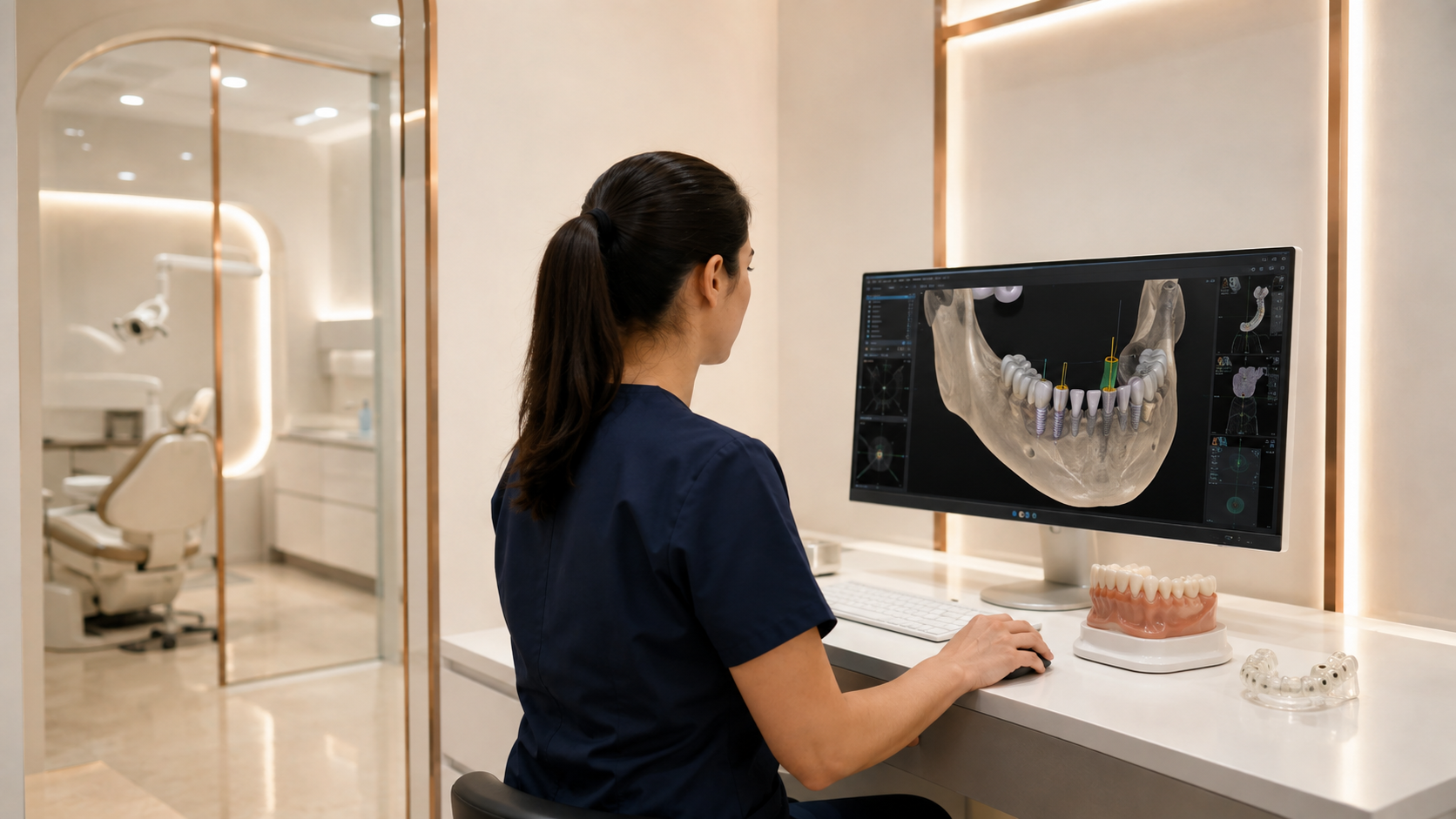
CBCT data and intraoral records can be evaluated together to plan implant angle, depth and position. When appropriate, a patient-specific surgical guide may be produced to transfer this plan to the mouth.
Guided surgery and flapless surgery are not the same. Guided placement may be performed with or without raising the gum, depending on the access and visibility required for safety.
Placement and healing
- A personalised plan is prepared after examination, 3D imaging and oral records.
- A surgical guide is produced if it is considered beneficial.
- The implant is placed in the planned position under appropriate anaesthesia.
- Initial stability and surrounding tissues are checked; a temporary tooth is considered only when clinical conditions permit.
- After healing, a scan or impression is taken for the final restoration.
Potential benefits and limitations
In carefully selected cases, less manipulation of the gum may help reduce early swelling and discomfort. Flapless treatment does not mean pain-free, risk-free or suitable for everyone.
A conventional surgical approach may be safer when bone augmentation is needed, bone volume is insufficient, infection is present or direct visibility is required. Benefits and risks are explained individually after examination.